Infrared (Thermal) Imaging Terms
Absolute Temperature - Absolute zero is the lowest
temperature that can be obtained in any macroscopic system. Absolute temperature
means temperature measured on a scale with absolute zero as 0. This is
conventionally measured in Kelvin.
Absolute zero - At absolute zero, a hypothetical
temperature, all molecular movement stops. All actual temperatures are above
absolute zero. Absolute zero would occur at -273.16 degrees C, -459.69 degrees
F, or 0 Kelvin.
Absorption - The process whereby the incident
particles or photons of radiation are reduced in a number or energy as they pass
through matter, i.e. the energy of the radiation beam is attenuated.
Air leakage - Unintentional air leaking into or
out of a building through cracks and small openings.
Anomaly - The deviation of the value of a
parameter, such as temperature, from its average or normal value.
Apparent temperature - The uncompensated reading
from an IR camera where emissivity is set to 1.0 and distance is set to 0.
Arc flash - A short circuit through the air. When
insulation or isolation between electrified conductors is breached or can no
longer withstand the applied voltage, an arc flash occurs.
ASNT - The American Society for Nondestructive
Testing (NDT). The organization of NDT professionals. Offers many services and
products of interest to the NDT community.
ASTM - American Society for Testing and Materials.
An organization to establish test standards for materials, products, systems,
and services for a wide range of materials.
Atmospheric attenuation - A decrease in the
intensity of infrared radiation due to absorption and scattering in the
atmosphere.
Auto Image Adjust - Automatic camera or software
function that adjusts Level and Span based on image content.
Black body - A theoretical object that radiates
the maximum amount of energy at a given temperature, and absorbs all the energy
incident upon it.
BTU - British Thermal Unit. The amount of heat
required to raise the temperature of 1 pound of water by 1 degree
Fahrenheit.
Calibration - The process whereby the magnitude of
the output of an infrared camera is related to the magnitude of the input
radiation from black body references.
Calorie - The standard unit for energy measurement
in nutrition. Equal to one kilo calorie or 1,000 calories.
calorie - Energy unit; a single calorie is the
amount of heat needed to increase the temperature of one gram of water by one
degree Celsius.
Celsius - A temperature scale in which zero
degrees is the freezing point of water and 100 degrees is the boiling point.
Certification - A process, by which an
agency/organization validates, based upon predetermined standards, an individual
Thermographers qualifications and Knowledge for practice in a defined
application.
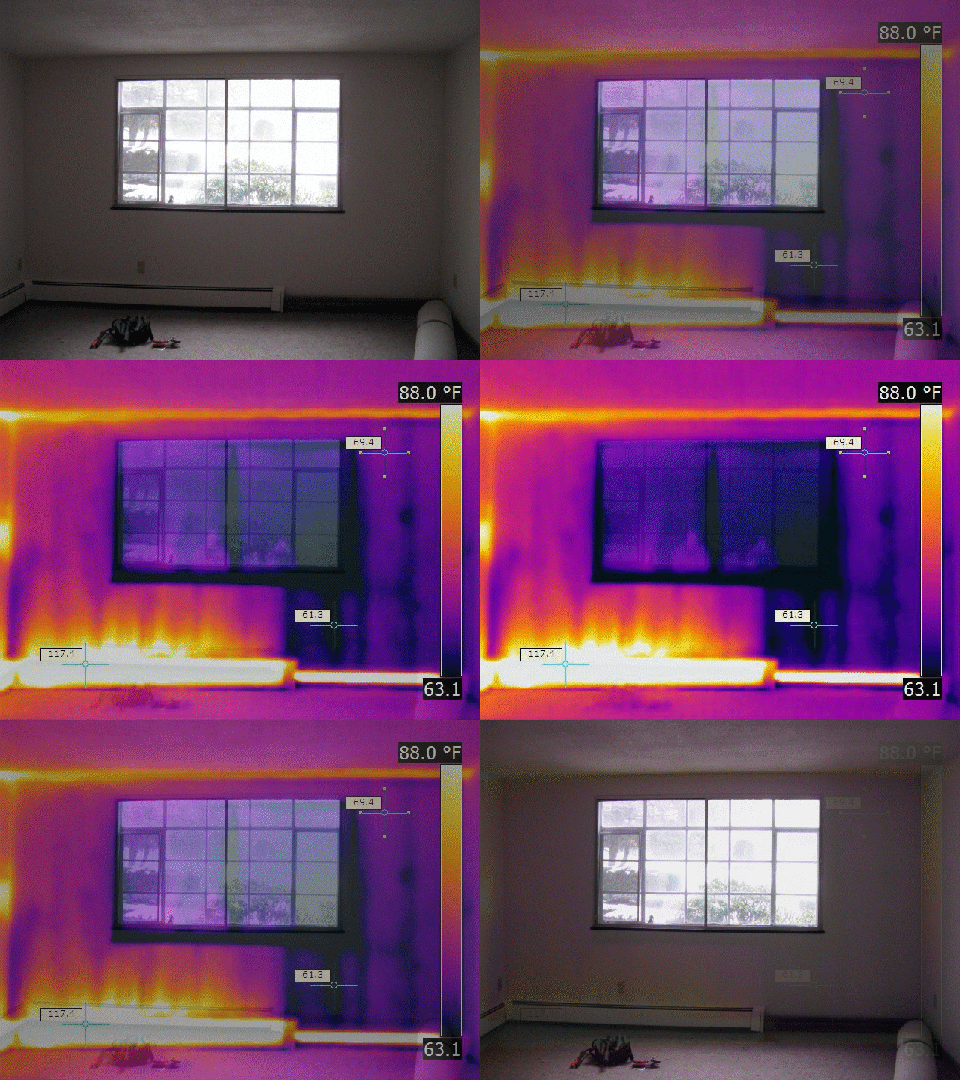
Color Palette - Scheme that assigns colors to
various image gray levels.
Condensation - The change of phase of a substance
from a vapor to a liquid. This is the opposite of evaporation. The process of
condensation releases energy; this energy is known as latent heat.
Condition based maintenance - An equipment
maintenance strategy based on measuring the condition of equipment in order to
assess whether it will fail during some future period, and then taking
appropriate action to avoid the consequences of that failure.
Conduction - The transfer of heat energy through a
substance or from one substance to another by direct contact of atoms or
molecules.
Convection - Transport of heat by the movement of
a fluid.
Diffuse reflection - The random reflection from a
rough surface, which results in a fuzzy, scattered reflection.
Electromagnetic spectrum - The ordered series of
all known types of electromagnetic radiation, arranged by wavelength ranging
from the short cosmic rays through gamma rays, X-rays, ultraviolet radiation,
visible radiation, infrared radiation, microwaves, to the long wavelengths of
radio energy.
Emissivity - The ratio of energy emitted by an
object to the energy emitted by a black body at the same temperature.
Energy - The capacity for doing work. Forms of
energy include thermal, mechanical, electrical, and chemical. Energy may be
transformed from one form into another.
Equilibrium - A system is in equilibrium when its
temperature properties are uniform and not changing with time.
Evaporation - The process whereby atoms or
molecules in a liquid state (or solid state if the substance sublimes) gain
sufficient energy to enter the gaseous state. This takes thermal energy and
cools the surface where evaporation is occurring.
Fahrenheit - Temperature scale based on 32F for
the temperature at which water freezes and 212F for the temperature at which
water boils (180 difference). Conversion to Fahrenheit from the Celsius
temperature scale is by the following formula: F = 9/5C + 32, where C is the
temperature in degrees Celsius.
Focus - Maximum clarity or distinctness of an
image rendered by an optical system; "in focus";"out of focus.
Forced Convection - Convection aided by wind or
mechanical means such as a pump or blower.
FoRD - Focus, Range and Distance. Parameters that
cannot be adjusted in IR software, hence must be correct before an image is
saved, or the readings will be compromised.
Germanium - A brittle, grayish-white metallic
element having semiconductor properties. Commonly used to make infrared camera
lenses.
Heat - A form of energy that is transferred by a
difference in temperature.
Heat Capacity - The amount of heat required to
raise the temperature of a specific quantity of a substance by one
degree.
Heat Transfer - The process of thermal energy
flowing from a body of higher temperature to a body of lower temperature via
conduction, convection, and/or radiation.
HVAC - Heating, Ventilation and Air Conditioning.
A system that provides heating, ventilating and/or cooling within or associated
with a building.
Incident radiation - The total radiation going to
an object.
Indirect Measurement - A situation where the
source of heating is buried far away from the surface being viewed by the IR
camera, resulting in a much lower temperature.
Infrared - Infrared (IR) radiation is
electromagnetic radiation of a wavelength that is longer than visible light, but
is shorter than microwave radiation. the name means "below red" (from the Latin
infra, "below") red being the color of visible light of the longest wavelength.
Infrared radiation spans three orders of magnitude and has wavelengths between
0.7 µm and 1000 µm (1 mm).
Inspection - The examination of the condition of a
system by an expert.
Insulation - Any material that offers resistance
to heat transmission. When insulation is placed in walls, ceilings or floors it
reduces the loss or gain of heat from outside sources.
Isotherm - A measurement tool that highlights
areas of equal apparent temperature.
Joule - It's a metric unit of work or energy,
equivalent to one watt second.
Kelvin - It's a unit of temperature equal in size
to the Celsius degree, but with the zero set by the absolute zero of
temperature, -273.15 degrees Celsius. Ice will melt at 273.15 Kelvin, room
temperature is about 293 degrees Kelvin, and water boils at 373.15 Kelvin, at
sea level. Average human body temperature is 310 degrees Kelvin. Are you
confused yet?
Kirchhoff's Law - At equilibrium, the radiation
emitted must equal the radiation absorbed.
Level - Thermal "brightness" adjustment on an
infrared camera.
Load - The amount of electric power or energy
delivered or required at any specified point or points on a system.
LW - Infrared energy in the region from 8-13
µm.
MW - Infrared energy in the region from 2-5
µm.
Natural convection - Heat transfer between a
surface and adjacent fluid (usually air) and by the flow of fluid from one place
to another, induced by temperature differences rather than by mechanical means,
also called free convection. Compare with forced convection.
Newton's law of cooling - Newton's Law says that
the time a substance takes to cool off depends on the temperature difference
between the substance and the surroundings.
NFPA - National Fire Protection Association. NFPA
has developed a scale for rating the severity of fire, reactivity and health
hazards of substances.
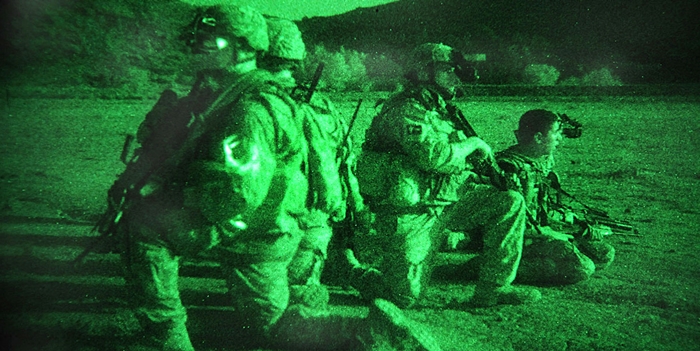
Night Vision - Night vision is being able to see
in the dark. Technological night vision works on one of two principles. The
first is by detecting infrared radiation, which is a form of energy emitted by
all objects regardless of the ambient light conditions. A device based on this
principle is called an infrared camera. The second is by intensifying the small
amount of light present (even at night) from the stars and the moon.
NIR - Near Ir-electromagnetic radiation with
wavelengths about 0.7 - 2 µm.
Normal - Perpendicular or at right angle to a
plane.
PPE - (Personal Protective Equipment) Safety
devices or safeguards worn by workers to protect against environmental hazards.
PPE includes helmets, safety goggles, hearing protectors, face shields,
respirators, arm guards, smocks, gloves, and safety boots.
Qualification - Demonstrated skill, knowledge,
documented training, and documented experience for thermography
applications.
Qualitative - Indicative only of relative
magnitudes, rather than their numerical values. A qualitative comparison would
say whether one thing is hotter, cooler, or the same temperature to another,
without specifying the magnitude of any difference. As opposed to
quantitative.
Quantitative - A quantitative property can be
meaningfully measured using numbers; properties which aren't quantitative
properties include: the number of grains of sand on a beach, the temperature of
a tire, and the time for a hammer to fall a certain distance.
R-value - A measure of resistance to the flow of
heat through a certain material. The greater the thermal insulating capability,
the higher the R-value.
Radiation - Energy transport (such as heat)
through electromagnetic waves.
Range - The lowest and highest temperatures that
can be imaged and or measured with an IR camera's detector setting. Most cameras
have several overlapping ranges.
Rankine -Absolute temperature scale based on the
Fahrenheit scale, but with zero R defined at absolute zero. 0 degrees F
corresponds to 459.67 degrees Rankine.
Re-certification - A review of all factors for
continuing a Thermographer's certification for an additional 5 years.
Reflected apparent temperature - The apparent
temperature of objects whose radiant energy is reflected off the target into the
IR camera.
Reflectivity - The proportion of incident
radiation reflected by a surface, expressed as a fraction or percentage.
Refractory - A heat-resistant material (usually
nonmetallic) which is used for furnace linings and such.
Relative humidity - The ratio of water vapor
contained in the air compared to the maximum amount of moisture that the air can
hold at that particular temperature and pressure.
Report - A written document describing the
findings of your Infrared (thermal) imaging scan. See "sample"
Route - A path which is planned and followed
regularly with equipment to be inspected along the way.
Severity classification criteria - A means for
ranking thermal anomalies for repair priority.
Solar loading - Heat added to objects by the sun,
that is not self-generated due to a problem.
Span - Thermal "contrast" adjustment on an IR
camera. Adjusting the span will change the temperature span between black and
white on an image.
Spatial resolution - The clarity of a single image
or the measure of detail in an image.
Specular reflection - A mirror-like
reflection.
Spot pyrometer - A pyrometer is a non-contact
temperature measuring device.
Spot size ratio - Ratio of the distance from an IR
camera to an object compared to the size of the spot being measured (also called
D:S ratio).
SSR - Spot Size Ratio
|